


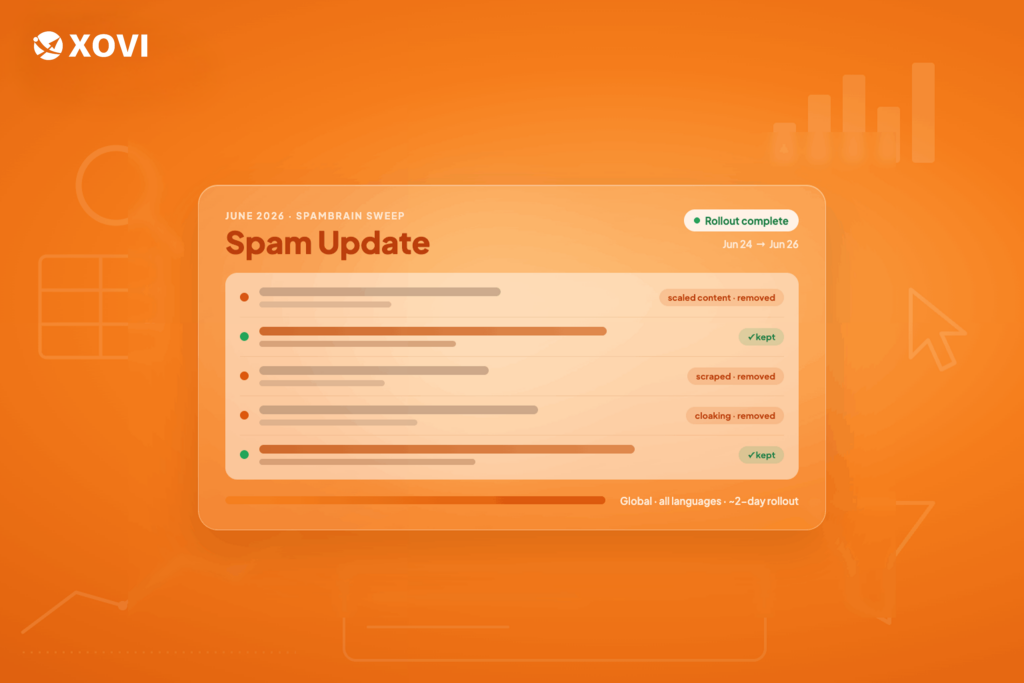

Google has finished rolling out the June 2026 spam update. It launched on June 24 and wrapped up on June 26, a roughly two-day rollout. For context, the March 2026 spam update finished in under a day, while the August 2025 one took nearly four weeks. If your rankings moved in the back half of June, this is a prime suspect.
What Google said (and didn’t say)
The announcement was sparse: a normal spam update, applying globally and to all languages, with no new spam policies attached. In Google’s framing, a spam update improves its automated spam-detection systems, chiefly the AI-based SpamBrain, rather than changing the rules. That signals sharper enforcement of existing policies, not a new rulebook.
Barry Schwartz noted it felt more widespread than a typical spam update, which squares with the bigger-than-usual movement many sites reported.
What it targeted
Google didn’t name a category. Early reporting suggests it does not target link spam or the site reputation abuse policy, which points to general spam-policy violations: scaled content abuse, scraped content, cloaking, and doorway pages. One point worth making plainly to clients: this does not penalize content for being AI-generated. Thin, duplicative, mass-produced pages get caught regardless of who or what wrote them.
One policy change worth flagging: in May 2026, Google updated its spam policies to explicitly call out tactics that try to manipulate AI responses in Search. That includes recommendation poisoning and biased listicles aimed at AI Overviews. Google has not confirmed this update enforces those rules, but the timing means clients optimizing aggressively for AI answers should review their tactics now. Understanding how AI tools actually describe a business is now part of spam-compliance risk, not just a visibility play, which is exactly what a tool like XOVI AI is built to surface: it shows how ChatGPT and other assistants describe a brand, so you can catch a misleading or manipulated representation before it becomes a liability.
Mind the May core update
Be careful attributing every June movement here. The May 2026 core update only finished on June 2, so changes in the second half of the month could trace to either event. The fixes are completely different, so isolate the cause before prescribing a remedy.
What to do if your site (or a client’s) was hit
- Confirm the timing: Look for step changes that line up with June 24 to 26, and check Search Console’s Manual Actions report. Daily ranking data beats weekly here, and a stable measure like XOVI’s OVI helps you tell a genuine drop from rollout noise.
- Diagnose by cohort, not sitewide: Spam updates tend to hit one page type. Grouping tracked keywords by page type lets you see which cluster actually moved.
- Cull thin, templated pages: Merge weak clusters into one strong canonical. An on-page audit surfaces the duplicate and thin pages worth consolidating before Google’s systems flag them.
- Strengthen proof and clean the link profile: Add real author bios, original data, and trust signals; shift over-optimized anchors toward descriptive ones. A clean profile is cheap insurance against the next update.
Set realistic recovery expectations
Recovery isn’t instant. Google has said its systems can take months to recrawl, reprocess, and credit fixes. Frame remediation as a 90-day audit-fix-validate cycle, not a one-week sprint.
The bottom line
If a site wasn’t using manipulative tactics, it should be fine. For everyone else, the playbook is the usual one: audit honestly, fix the real problems, and give Google’s systems time to catch up. Treat spam-policy compliance as ongoing hygiene, not emergency response, and the next rollout becomes a non-event.