
In Short
- Google Search Console now natively separates branded and non-branded search traffic in the Performance report.
- The filter uses an AI-assisted classification system, not regex or keyword matching.
- It is available for top-level domain properties only and requires sufficient query volume to appear.
- As of March 11, 2026, the filter has rolled out to all eligible sites.
- For agencies, this changes how SEO performance is measured, reported, and justified to clients.
- XOVI’s Rank Tracker, OVI visibility scoring, and Reporting Tool let agencies turn this segmentation into action, tracking non-branded keyword movement, benchmarking organic visibility, and packaging it all into client-ready reports.
Google Search Console now lets you separate branded and non-branded traffic natively. No workarounds, no regex filters, no manual keyword exclusion lists. The branded queries filter launched in November 2025 and rolled out to all eligible sites on March 11, 2026. For agencies reporting on organic performance, it changes what you can show clients and how you justify the work.
The underlying problem it solves is one every SEO knows well. A site ranking well for its own name looks like a success in Search Console. A site with almost no organic discovery can still post impressive click numbers simply because users are searching directly for the brand. Agencies knew this was an issue. Clients rarely did, until now.
What the Filter Actually Does
The new filter sits inside the Search Results Performance report and lets you segment query data into two views: Branded, which shows performance for queries that include your brand name or closely associated products, and non-branded, which covers everything else.
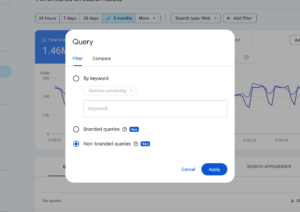
You can apply it across all search types, web, image, video, and news, and all standard metrics follow: impressions, clicks, average position, and CTR, scoped to whichever segment you have selected.
Google has also added a new card to the Search Console Insights report that shows the click split between branded and non-branded traffic directly. It frames the distinction around brand recognition versus organic discovery, which is a useful way to present it to clients who are new to the concept.
How Google Defines a Branded Query
This is where the update gets more interesting than a simple toggle.
A branded query is defined as one that includes your brand name, variations or misspellings of the brand name, and brand-related products or services. The classification is not based on a regular expression method of including or excluding keywords. It is determined by an internal, AI-assisted system that covers your website brand name in all languages, typos, and queries that don’t include the brand name but refer to a unique product or service of the site.
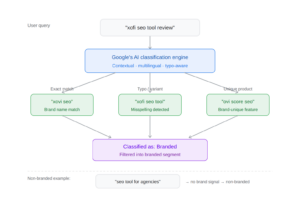
In practical terms, this means Google’s system will catch edge cases that manual regex filters would miss: a misspelled brand name, a product name that has become synonymous with the brand, or a branded term in a different language. Due to the dynamic and contextual nature of brand classification, some queries may occasionally be misidentified. That is worth keeping in mind when reviewing the data, but it does not undermine the filter’s overall usefulness.
It is also worth being clear about what this filter is not: it has no effect on how Google Search ranking works. This is purely a reporting and analysis tool.
Why This Matters for Agencies
The honest reality of SEO reporting is that branded traffic has long been used, sometimes unconsciously, to make organic performance look better than it is. A client with strong brand awareness will generate a lot of branded searches. Those clicks show up in Search Console alongside non-branded clicks, and the combined numbers can mask the fact that generic, discovery-driven rankings are underperforming.
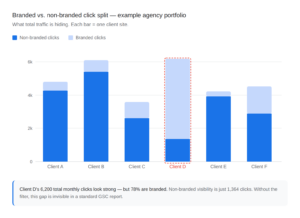
As SEO expert Eli Schwartz noted on LinkedIn, SEO teams will now be able to segment out where they helped with non-brand impact, but it also means that leadership will be able to filter out a lot of the brand noise some SEO teams hide behind.
That cuts both ways. For agencies doing solid non-branded SEO work, this filter is an opportunity to demonstrate real impact more clearly. For clients who assumed that high overall traffic numbers meant their SEO was working, it may prompt some difficult but necessary conversations.
Branded queries typically lead to higher-ranking pages from your site and result in higher click-through rates, whereas non-branded queries offer organic growth, as they show how new users find your content without any initial intent to go to your site. Knowing the split between the two is fundamental to understanding where actual growth is happening, and where it needs to happen.
Practical Uses for the Filter
Cleaner performance benchmarking. When you set a baseline for a new client, filtering out branded queries gives you a much more accurate picture of where their organic visibility actually stands. Non-branded impressions and clicks are a better proxy for the SEO work you are doing and the results it is driving.
More credible client reporting. Showing the branded vs. non-branded split in monthly reports adds a layer of transparency that clients increasingly expect. It also gives you a narrative: “Your branded traffic remained stable this quarter, and here’s how we grew non-branded visibility by X%.”
Diagnosing traffic changes. When a Google algorithm update affects performance, applying the branded and non-branded filters can help reveal whether branded traffic remained steady while non-branded queries declined, or vice versa, enabling appropriate action rather than internal blame.
Campaign attribution. If a client runs an offline campaign, a TV ad, or a PR push, you would expect to see a spike in branded searches. The filter lets you isolate that effect from organic discovery traffic, making it easier to connect media spend to search behavior.
Identifying growth gaps. A site with high branded traffic and low non-branded traffic is over-reliant on existing audience awareness. That gap represents a content and keyword targeting opportunity, and the filter makes it easy to show clients where the growth ceiling is if that gap is not addressed.
Who Can Access the Filter
The filter is only available for top-level domain properties. Sites using subdomain properties or URL path properties do not qualify. If a client’s Search Console is set up as example.com/subfolder or subdomain.example.com, the filter will not appear.
The filter also requires a sufficient volume of queries and impressions for Google’s AI classification to function. Very small sites or those with minimal brand search volume may not see the option even after the full rollout. Properties below the traffic threshold simply do not qualify, regardless of rollout timing.
How to Find It in Search Console
The filter appears inside the Search Results Performance report, alongside existing filters at the top of the report. From there, you can toggle between branded, non-branded, or both views. The Insights section on the Search Console overview page now also includes the split card showing total clicks broken down by query type.
If you manage multiple properties, it is worth checking each one individually, as eligibility varies by site.
Making the Most of This Data with XOVI
The branded queries filter gives you a cleaner data foundation inside Search Console. But segmentation alone does not tell you what to do next. That is where XOVI picks up.
Rank tracking by query type. Once you know which non-branded terms are driving clicks, XOVI’s Rank Tracker lets you monitor exactly how those positions shift week over week, across desktop and mobile, and across the DACH markets your clients care about. You are not just seeing that non-branded traffic went up or down. You are seeing which keywords moved and by how much.
OVI visibility scoring for the bigger picture. XOVI’s OVI score gives you a single visibility index that reflects how a domain performs across its full keyword universe. For clients with a high branded share in Search Console, the OVI quickly shows whether their broader organic visibility is growing or stagnating. It is a straightforward way to benchmark progress and compare performance against competitors in the same space.
Keyword discovery beyond what Search Console shows. Search Console only surfaces queries your site has already appeared for. XOVI’s Keywords Tool helps identify non-branded opportunities you are not yet ranking for, which is where the growth gap identified by the branded filter actually gets closed.
Client reporting that connects the dots. XOVI’s Reporting Tool lets you pull branded vs. non-branded performance trends, rank tracking data, and OVI visibility into a single report. For agency clients, this means one document that tells the full story: where traffic is coming from, what is driving rankings, and what the SEO work has actually produced.
Used together, the branded filter in Search Console and XOVI’s tracking and reporting tools give agencies a complete picture of what is driving organic performance and, more importantly, what to do about it.
Bottom Line
The branded queries filter in Google Search Console is not a dramatic technical change. It does not affect rankings. It does not change how Googlebot crawls or indexes content. But it does address one of the most persistent gaps in how organic performance has been measured and reported, and for agencies, that gap has always been a source of both confusion and convenient ambiguity.
Now that the data is clean and accessible natively in Search Console, the expectation will shift. Clients will start asking about the split. Leadership teams will want to see non-branded growth, not just total traffic. Agencies that are already comfortable with this segmentation will be ahead.
Check your eligible properties today, get the baseline data in place, and start building it into your reporting framework before your clients start asking why you haven’t.
Want to track how your non-branded rankings are developing week over week? Try XOVI free and see how our rank tracking and search analytics tools can support your agency’s reporting workflows.