



Key Takeaways
- AI visibility measures whether AI tools like ChatGPT accurately understand and recommend a business.
- SEO optimizes for how search engines rank pages. AI visibility diagnoses whether AI tools understand the business at all. A site can rank on page one and still be invisible in AI-generated answers.
- Poor AI visibility has fixable causes, such as inconsistent business information across platforms, missing service descriptions, weak category signals, and outdated data that AI tools still retrieve.
- For agencies, this is a new billable service layer. Clients are already noticing that competitors show up in ChatGPT. The agencies that can diagnose and fix that gap now will be ahead when the demand fully lands.
If you have recently typed your client’s business name into ChatGPT and received a vague, incomplete, or outright wrong description, you have already run into an AI visibility problem.
AI visibility is the new upstream layer of digital marketing. It determines whether AI tools understand, trust, and surface a business when users ask questions that matter to that business. In fact, AI search traffic converts at 14.2% compared to Google organic’s 2.8%. This is a 5.1x advantage. (73% of B2B Buyers Use AI Tools in Purchase Research, Multi-Source Analysis Finds,2026)
And right now, most agencies have no structured way to measure it or fix it for their clients.
This guide explains what AI visibility is, why it’s non-negotiable for agencies and freelancers, how it differs from traditional SEO, and exactly what you can do today to start building it into your service offering.
What is AI Visibility?
AI visibility is the degree to which AI tools accurately understand and surface a business’s brand, products, services, and expertise in response to relevant user queries.
When someone asks ChatGPT, Gemini, Perplexity, or any other AI assistant a question like –
“Who are the best project management consultants in Berlin?”
or
“What’s a reliable accounting software for small businesses?”
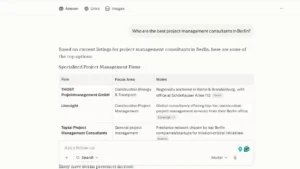
The businesses that appear in the answer have AI visibility.
More than appearing, it is how you appear that counts. A business can show up in an AI answer with the wrong description, outdated pricing, the wrong service category, or a competitor’s positioning accidentally attached to its name. This is still an AI visibility problem.
AI visibility has three dimensions:
- Access: Can AI crawlers technically read and retrieve the business’s website and online presence? If AI systems cannot access the content, nothing else matters.
- Understanding: Does AI correctly classify the business? Does it know what the business does, who it serves, what makes it different, and what its specific offerings are? Or is the information incomplete?
- Surface: When users ask relevant questions, does the business appear in AI-generated answers? And when it does appear, is the information accurate and favorable?
These three dimensions work in sequence. You cannot have surface without understanding, and you cannot have understanding without access. Hence, diagnosing AI visibility requires a structured, layered approach.
Why AI Visibility Matters Now
AI search is a channel your clients’ buyers are already using, and it’s making decisions about which brands to recommend before those buyers ever visit a website.
The numbers tell the story clearly.
- 94% of B2B buyers are now using generative AI or conversational search in their buying process, and twice as many buyers name it as a more meaningful source of information than vendor websites, product experts, or sales (B2B Buyers Make Zero-Click Number One, Forrester,2026). For your clients, that means the pitch deck and the sales call now matter less than what ChatGPT says about them before either happens.
- Traditional search engine volume will drop 25% by 2026 as users shift toward AI assistants and chatbots for discovery (Gartner Press Release, 2024). That’s not a future problem to plan for later. It’s an ongoing shift in where your SEO budget needs to start covering new ground.
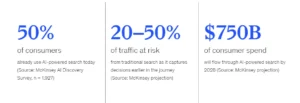
- McKinsey’s October 2025 consumer survey found that approximately 50% of consumers across all demographics intentionally use AI search for purchasing decisions (New front door to the internet: Winning in the age of AI search,2025). Half of your client’s prospects are forming an opinion before a single click reaches the website you’ve been optimizing.
However, showing up in ChatGPT doesn’t suffice. AI visibility is also about whether the version of your client that AI tools present to buyers is accurate enough to win their trust. The problem is often about misrepresentation:
For agencies, that creates a specific and urgent responsibility to control the accuracy of what those answers say.
That’s a different brief than SEO. It requires auditing information across the entire digital footprint. It requires monitoring channels that most agencies don’t currently track. And it requires being able to show clients, with data, what AI tools are saying about them right now and what it is costing them.
AI Visibility vs. SEO: Understanding the Difference
This distinction matters most for agencies because it defines where AI visibility fits in your existing service stack.
SEO answers: How do we rank? How much traffic are we getting? Which keywords are performing?
AI visibility answers: Do AI tools understand this business at all? Are they surfacing it in the right conversations? Is the information they are using accurate?
While SEO measures rankings, AI visibility diagnoses understanding. A business can rank on page one for a target keyword and still be misclassified or completely absent in AI-generated answers. Conversely, improving AI visibility also benefits traditional search.
What Causes Poor AI Visibility?
Understanding the causes of poor AI visibility is the first step to fixing it. Five common root causes affect most businesses.
1. Inconsistent Information Across Platforms
AI systems build their understanding of a business by aggregating information from multiple sources:
- The website
- Directory listings
- Review platforms
- Social profiles
- News mentions
When that information is inconsistent, AI systems get a fragmented picture. And, a fragmented understanding leads to reduced surfacing.
2. Missing Entity Information
Entities are the building blocks of how AI systems categorize the world. A business entity needs clear signals:
- What category does it belong to
- What it offers
- Who it serves
- Where it operates
- What makes it distinct
When those signals are missing or weak, AI tools either misclassify the business or skip it entirely in favor of one with clearer signals.
3. Inadvertent Blocking of AI Crawlers
Many websites unintentionally block AI crawlers through overly broad robots.txt rules or security configurations that flag bot traffic.
Regardless of how good the content is, if an AI system cannot technically access a site, it cannot build an accurate picture of the business.
4. Outdated Information in AI Training and Retrieval Data
AI tools work from a combination of training data and real-time retrieval. If a business has rebranded and the updated information hasn’t been clearly published, AI tools may still be working from an outdated version of the business. This creates a gap between how the business presents itself and how AI describes it.
5. No proactive AI visibility strategy
Sometimes, low AI visibility is due to negligence. It happens when businesses fail to –
- Actively audit their AI presence
- Check how AI tools describe them
- Identify gaps and conduct structural changes to improve AI understanding
The Five Pillars of AI Visibility
A structured approach to AI visibility follows five interconnected pillars. Miss one layer and the work above it doesn’t hold. Here’s what each pillar means and what to actually do about it.
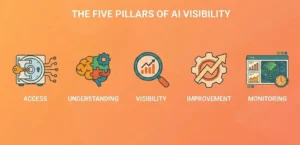
Created using Gemini
1. Access
Start here. Every time. If AI crawlers cannot access the site, the rest of this list is irrelevant.
- Check robots.txt for rules that are blocking AI user agents unintentionally.
- Check whether key pages rely on JavaScript rendering that bots can’t execute
- Check whether security configurations are flagging legitimate crawler traffic
If access is blocked or restricted, no amount of content work will improve AI visibility. Fix access first.
2. Understanding
Once access is confirmed, the next question is: what does AI actually know about this business? This means examining how AI tools currently classify the business.
Understanding analysis reveals the information gaps:
- What’s missing
- What’s conflicting
- What’s outdated
These gaps are the specific items that need to be fixed to improve how AI systems represent the business.
3. Visibility
With access confirmed and understanding gaps mapped, you can measure what’s actually happening in AI-generated answers.
Run queries that your client’s buyers are asking. Note which businesses appear and which don’t. Then look at the ones that do. What information do they have that your client lacks? It’s a direct, side-by-side comparison of what’s working and why.
This is also the section of an audit that clients respond to quickly. Showing someone that their competitor appears in ChatGPT for a query they should own is worth more than a hundred slides of market analysis.
4. Improvement
Don’t give clients a 40-point checklist. Give them a ranked action plan.
- Fix access issues first — they are binary and often quick.
- Address the biggest entity gaps: missing or conflicting information that directly explains why AI tools are misclassifying the business.
- Move to content structure. Are key pages written in a way that makes the business’s category, services, and audience clear?
- Tackle external data sources: directories, profiles, and review platforms.
Every item on the list should map back to a specific gap identified in pillars one through three.
5. Monitoring
One audit tells you where things stand today. However, it does not tell you what changes next month.
AI tools update how they retrieve and represent information. Competitors make improvements. New data sources surface that conflict with what you have established. Without monitoring, you learn about these changes only when your client calls.
A scheduled scan catches the things a one-time audit can’t. For instance, a competitor who just fixed their entity signals and started outranking your client in AI answers, a directory listing that went stale and introduced a conflicting address, or a sudden drop in Query Success after an AI tool changes how it retrieves information.
To establish your agency as one that manages AI visibility as an ongoing discipline, you need to –
- Set up scheduled scans
- Track the AI Visibility Score over time
- Flags change before they become problems
How to Build AI Visibility into Your Agency Service Offering
For agencies and freelancers, AI visibility is most effectively introduced as a structured, repeatable service. Here’s how to build it in.
Start with an AI Visibility Audit for Every New Client
Before any other work begins, run a full AI visibility audit. This gives you a baseline about how AI currently understands the client’s business. It also gives you a concrete, data-backed starting point for conversations about what needs to change and why.
An audit at onboarding reframes the agency relationship from the start. You can manage the client’s presence across every channel where their buyers are making decisions.
Use AI Visibility Findings to Inform Content and SEO Strategy
AI visibility gaps do not exist in isolation. When you identify AI visibility gaps, use those findings to inform your broader content and on-page strategy. This makes AI visibility work doubly valuable. It improves AI presence and strengthens traditional search performance at the same time.
Build AI visibility into Monthly Reporting
Clients need to see the work making a difference. Hence, you need to include AI visibility score trends in every monthly report alongside traditional SEO metrics. When the score improves, the data shows it.
Adding AI visibility metrics to reporting also differentiates your agency from those still reporting only on rankings and traffic. It demonstrates that you are managing a broader, more complete picture of the client’s digital presence.
Package AI visibility as a Standalone Offering
Every client relationship does not necessarily start with a full retainer. AI visibility audits give prospective clients a clear picture of where they stand and what they are missing. This creates a natural pathway from audit to ongoing management.
XOVI’s White-label reporting makes this straightforward. Deliver a professional, branded AI visibility audit report that the client can review independently.
Educate Clients Before You Pitch The Service
AI visibility is a new category. Hence, before pitching the solution, you need to spend time on the problem.
Explain what AI visibility is, why it matters for their specific business, and what the cost of ignoring it looks like. The agencies that do this education work now will be the ones clients trust when AI visibility becomes a mainstream concern.
What Riva Does
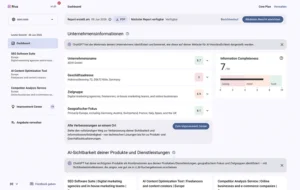
Riva is an AI visibility platform that shows how AI tools interpret and surface a business and its individual offerings compared to competitors in AI-powered search. It reveals information gaps that limit visibility and provides a clear roadmap to improve how a brand appears as buying decisions increasingly shift toward AI-powered discovery.
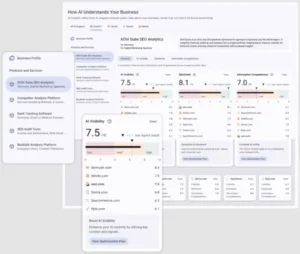
For agencies and freelancers, Riva delivers the structured process that AI visibility work requires. Key capabilities are as follows –
- Access check: Identifies whether AI crawlers can technically access the site and flags specific technical barriers that limit AI access. This is the first check in every audit. You can catch a robots.txt rule blocking AI crawlers before you bill a client for a content fix that was never going to work.
- Understanding analysis: Shows how AI currently classifies the business, what information is missing, and where the entity signals are weak. This is where the specific gaps that limit AI visibility are identified. Instead of telling a client “AI doesn’t get us,” you tell them their service area is missing from three sources, and their category is wrong in one.
- Competitor benchmarking: Lists which competitors appear in AI answers for relevant queries and why. You can show a prospect the exact prompt where a named competitor gets recommended instead of them, and you have justified the retainer before you have pitched it.
- Improvement Center: Generates a prioritized list of actionable recommendations tied to the specific gaps identified in the audit. You get a ranked fix list instead of spending the first week of a retainer deciding where to start.
- Scheduled monitoring: Sets up recurring AI visibility scans to track changes over time. Catch the week when a competitor’s Query Success score jumps, instead of finding out when the client asks why they have gone quiet.
- AI Visibility Score: A single, trackable metric that moves as improvements are made and provides a clear benchmark for client reporting. Drop one number into next month’s report, and the client sees progress without you explaining what changed.
- Client-ready exports and white-label reporting: Produces professional, branded reports ready for client delivery without additional formatting work. That’s billable hours you save instead of spending them rebuilding a deck under your own logo before a client call.
How to Sell AI Visibility to a Client Who Has Never Heard of It
Most clients won’t come to you asking for AI visibility. They will come to you saying their leads have slowed down or that a competitor seems to be everywhere lately. Your job is to connect those dots. Here’s how.
- Open with the demo, not the pitch: Ask them to type their business name or a core service into ChatGPT. Let them see the result before you say a word. Wrong descriptions, missing services, or a competitor mentioned instead are the most persuasive moments.
- Make it about the buyer: Do not lead with technology. Lead with this: “Your buyers are asking AI tools for recommendations before they visit any website. Here’s what those tools are telling them about you.”
- Show the competitor gap immediately:Pull up who’s appearing in AI answers instead of them. Names, categories, side-by-side. Clients act on concrete comparisons faster than abstract problems.
- Separate it clearly from SEO: Tell them the difference between SEO and AI visibility. Focus on how it is a different channel that does not cover rankings.
- Lead with the audit: Offer a standalone AI visibility audit as the entry point. Low commitment, high insight, natural pathway to ongoing work.
What AI Visibility Means for Your Agency
For agencies and freelancers, AI visibility is a new and growing service layer. It is a trend that sits upstream of SEO and addresses a gap that traditional tools do not cover. Clients are already noticing the problem. The agencies that build a structured, repeatable approach to AI visibility will be ahead. The clients asking for it are already here.
Ready to start measuring AI visibility for your clients? Try Riva. It gives agencies and freelancers the platform to run structured AI visibility audits and track AI visibility scores over time.
See how AI tools describe your first client in minutes. Start your 14-day free trial today!
Frequently Asked Questions
How often should AI visibility be monitored?
AI visibility should be monitored on a scheduled, recurring basis. AI tools update how they retrieve and represent information over time. Hence, monthly monitoring provides a consistent baseline and flags changes before they become problems. For agencies, scheduled monitoring provides clients with continuous visibility into a channel that is constantly evolving.
Why would a well-ranked website have poor AI visibility?
Google rankings are built on keyword optimization and technical performance. These signals do not automatically translate to AI visibility. AI tools build their understanding of a business from entity signals like consistent descriptions across platforms, clear service and category information, and structured data.
What is the difference between AI visibility and SEO?
SEO measures how a website ranks in traditional search engines like Google. On the other hand, AI visibility measures whether AI tools like ChatGPT, Gemini, and Perplexity understand and recommend a business when users ask questions directly. The core difference is that search engines rank pages and AI tools generate answers. A business can rank on page one of Google and still be absent or misrepresented in AI-generated answers.
My client's competitor keeps appearing in ChatGPT answers instead of them. How do I fix it?
This is an AI visibility gap, and it has a diagnosable cause. AI tools favor businesses with complete information, like accurate service descriptions and coherent category signals. When a competitor appears instead of your client, it means the competitor has stronger entity signals. Riva shows exactly which competitors appear in AI-generated answers for relevant queries. It tells you precisely what to address rather than requiring you to guess.