



Key Takeaways
- Manual AI checks do not scale. If you are checking the prompts one by one for each client, the process gets tedious once you manage more accounts.
- Every audit should follow the same Access → Compare → Improve framework, with ongoing monitoring used to track change over time. Using the same framework across clients makes results easier to compare over time.
- Competitor benchmarking turns a visibility score into something a client can actually act on. A visibility score alone without context cannot add much value.
- With Riva, agencies can apply a consistent offering-level AI visibility workflow across client accounts and track changes over time.
Managing AI visibility audits across multiple client accounts means running the same structured process for every client. Instead of manual, one-off prompt checks, you standardize the framework. You standardize competitor comparison, improvement prioritization, and reporting across accounts.
Twelve client accounts. One person copy-pasting the same prompt into ChatGPT, then Perplexity, then Gemini, then screenshotting whatever comes back. That is how most agencies are handling AI visibility right now, and it is already breaking.
This is not because the checks are wrong. It is because nothing about that process holds up once you move past two or three clients. Nobody remembers which prompt they used last month. Nobody can tell a client whether things have improved or just changed. Agencies running five or thirty accounts need a system that runs the same way every time, for every client, regardless of who’s running it.
This blog walks you through how to build that system and manage it at scale with Riva.
Why Manual AI Checks Break Down Across Multiple Clients
One client, one prompt, one AI tool. That is manageable. Multiply it across accounts, and the process falls apart fast.
- Different team members phrase prompts differently and get different answers
- There is no fixed record to compare this month against last month
- Hours go into copy-pasting prompts instead of fixing the actual gaps
- Findings live in someone’s memory or a messy spreadsheet, not a repeatable process
If AI visibility work sits next to an SEO retainer, it needs the same structure. Clients expect consistent reporting either way.
Riva approaches this differently. The workflow starts with the client’s offerings rather than manually rebuilding a prompt list for every account. Riva generates relevant queries and prompts around each offering.
The Framework Behind a Repeatable AI Visibility Audit
Before adding more clients to the workload, fix the process itself. Every audit should follow the same core process each time.
- Access: Can AI systems reach the relevant website information?
- Compare: Do the business and its individual offerings appear for relevant questions, and which competitors surface instead?
- Improve: What missing, outdated, unclear, or conflicting information should be addressed next?
- Monitor over time: Rerun the analysis consistently to see how visibility changes after improvements.
Riva uses Access → Compare → Improve as the core framework, with reports rerun every two weeks for ongoing monitoring.
Apply the same Access → Compare → Improve framework across clients, then use ongoing monitoring to compare changes over time.
How Riva Manages Audits Across Multiple Client Accounts
Riva gives agencies a consistent structure for applying the same AI visibility methodology across multiple client accounts without rebuilding the process each time.
The workflow stays consistent across accounts: check access, review offering-level visibility and competitor context, prioritize improvements, and monitor change over time.
The same audit structure can be applied consistently across the client accounts you manage.
Here is the practical workflow –
Step 1: Run the Access check
Riva checks whether relevant website information is technically accessible to AI systems, giving agencies a clear starting point for each client.
Step 2: Review Offering-Level Visibility
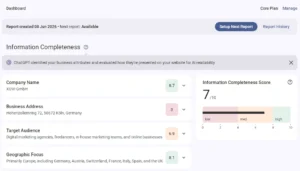
Riva starts with the offerings it identifies for the business. Users can add additional offerings where needed, and Riva generates relevant queries and prompts around each one. Review whether those offerings appear and where visibility gaps emerge.
Step 3: Benchmark Against Named Competitors
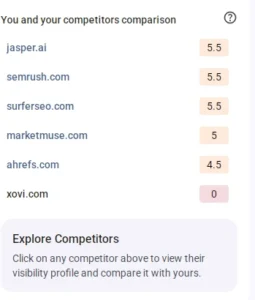
Riva shows which competitors surface instead of the client and provides context for where offering-level visibility is weaker. This turns an abstract score into a concrete conversation.
Step 4: Open the Improvement Center
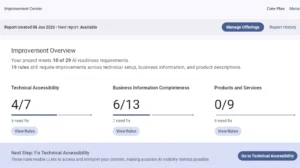
Use the Improvement Center to prioritize identified gaps and turn them into clear next actions for the client.
Step 5: Set Scheduled Monitoring
Track the AI Visibility Score over time rather than relying on a one-off snapshot. Riva reruns reports every two weeks, giving agencies a consistent basis for tracking visibility changes and reporting progress.
Step 6: Export White-Label Reports
Use Riva’s client-ready exports to communicate scores, findings, and prioritized improvements without rebuilding every report manually.
Build a Repeatable AI Visibility Process Across Clients
Running AI visibility audits across multiple accounts by hand is not a time problem you fix with more hours. It is a process problem. Riva checks access, compares offering-level visibility against competitors, identifies prioritized improvements, and reruns reports every two weeks.
Start your free trial of Riva and apply a structured AI visibility workflow to your client accounts.
Frequently Asked Questions
What's the difference between an SEO audit and an AI visibility audit?
An SEO audit focuses on traditional search performance, technical SEO, rankings, and related search data. An AI visibility audit looks at whether relevant information is accessible, whether the business and its offerings appear in AI-powered discovery, which competitors surface instead, and what should be improved.
How often should agencies run AI visibility audits for clients?
Consistency matters more than choosing an arbitrary monthly or quarterly cadence. Riva reruns reports every two weeks, giving agencies a repeatable basis for comparing visibility over time.
Can AI visibility audits guarantee a client shows up in AI answers?
No. AI visibility work helps identify and improve controllable issues such as access, unclear information, and offering-level gaps. It does not guarantee a specific mention, recommendation, ranking, or placement.
How do agencies present AI visibility results to non-technical clients?
Keep the report outcome-focused. Include a visibility score, offering-level comparison, competitor context, and a short list of prioritized improvements. Avoid explaining how AI models supposedly work internally. Clients need to understand what changed, what needs attention, and what happens next. Riva’s client-ready reporting can support that conversation.
What is the biggest mistake agencies make when scaling AI visibility work?
Treating each client as a one-off manual check instead of building a repeatable system. Without a fixed framework, results vary by whoever ran the check that week, and there is no clear way to compare progress consistently. The fix is standardizing the process and monitoring across every account from the start.