



Google has started rolling out its November 2026 Core Update, and search rankings are already showing significant volatility. Here’s what website owners and SEO professionals need to know, and how to prepare.
On November 10, 2026, Google officially began rolling out its latest core algorithm update. According to the Google Search Status Dashboard, the update affects search results globally, across all languages, and may take up to two weeks to complete.
Early data from third-party SEO monitoring tools, including Semrush Sensor, indicates unusually high ranking volatility in some markets.
If you’ve noticed unexpected changes in your Google rankings, you’re not alone. However, a ranking change doesn’t necessarily mean something is wrong with your website.
Let’s look at what’s happening and what you can do about it.
What Is the November 2026 Google Core Update?
Google regularly updates its search algorithms to improve the quality and relevance of search results.
Core updates are broader changes to Google’s ranking systems. Unlike updates targeting specific types of spam or technical issues, core updates reassess how content is evaluated and prioritized across search results.
This means that websites may experience:
- Ranking fluctuations: Previously stable keywords may move up or down.
- Changes in organic traffic: Search visibility changes may affect website visits.
- Shifts in competitor visibility: Competing websites may gain or lose positions.
- Changes in page performance: Some pages may be affected more than others.
Importantly, these changes do not automatically indicate a penalty or an SEO mistake.
Google explains that core updates are designed to surface more helpful and reliable content, rather than target individual websites.
How Significant Is This Update?
Early volatility indicators suggest that search results are experiencing considerable movement.
Semrush Sensor, which monitors daily fluctuations in Google search results, showed a volatility score of approximately 9.4 out of 10 for US desktop searches on November 12, placing it in the “Very High” category.
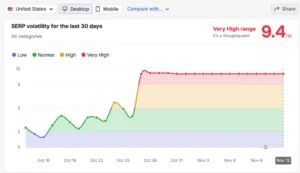
That level indicates substantial movement in the monitored search results.
However, there are two things to remember.
First, ranking volatility does not mean every website will lose traffic. Some websites may gain visibility, while others remain relatively stable.
Second, volatility was already elevated before Google’s November 10 announcement. Therefore, not all observed ranking changes can be attributed directly to this core update.
The full impact will become clearer once the rollout is complete.
Update, November 13, 2026: Not Every Ranking Drop Is Real
SEO providers, including Semrush, have reported that some automated Google searches return unusual or irrelevant results. These results can look completely normal but may differ from what users actually see when searching on Google.
For SEO tools, this creates a challenge. If these results are recorded as genuine ranking data, individual keywords may suddenly appear to lose positions or disappear from the rankings entirely, even though their actual visibility may not have changed.
What does this mean for your website?
If you notice sudden or unusually large ranking drops, don’t immediately assume the Core Update is responsible. Compare changes over several days and check your Google Search Console data to see whether clicks and impressions show a similar pattern.
It’s important to distinguish between actual ranking changes and potential data collection issues. The two can occur at the same time, but they are not necessarily connected.
Google has not publicly confirmed the suspected deliberate delivery of such results to automated tools.
Read more in Semrush’s article on Poisoned SERPs.
What Should You Do If Your Rankings Change?
The most important advice is simple: Monitor first, analyze carefully, and avoid making rushed changes.
Here are five practical steps.
- Monitor Your Keyword Rankings
Start by checking whether your most important keywords have changed positions.
Focus on keywords that drive relevant visitors, leads, or sales rather than reacting to every minor movement.
With XOVI’s keyword monitoring, you can track ranking developments over time and identify which keywords are gaining or losing visibility.
Look for patterns rather than isolated changes.
For example, are multiple keywords associated with one product category losing positions? Or are fluctuations limited to a few individual search terms?
Understanding the scope of the changes will help you decide whether further investigation is necessary.
If an individual keyword suddenly drops significantly or appears to disappear from the rankings, compare the data with Google Search Console before taking action. This can help you identify whether the change reflects actual search performance or a potential measurement issue.
- Compare Your Visibility With Competitors
A ranking drop doesn’t always mean your website has become worse.
Sometimes, competing pages simply perform better under Google’s updated evaluation systems.
Use XOVI’s competitor analysis to examine how competing domains are performing.
Ask yourself:
- Are your competitors experiencing similar fluctuations?
- Which websites are gaining positions for your target keywords?
- Have different types of content started appearing in the search results?
- Are competitors addressing search intent more effectively?
These comparisons can help you identify whether a change affects your entire market or specific areas of your website.
- Review Your Most Important Pages
If significant ranking losses persist after the rollout, take a closer look at the affected pages.
Google recommends focusing on helpful, reliable, people-first content.
Consider whether your pages:
- Answer the questions visitors are actually asking.
- Provide accurate, current, and useful information.
- Offer meaningful value compared with competing pages.
- Have clear headings and an understandable structure.
- Demonstrate relevant knowledge and experience.
XOVI’s on-page analysis and content optimization features can help identify technical and content-related opportunities.
Remember, improving content should focus on helping visitors, not simply changing text to satisfy an algorithm.
- Check for Technical SEO Issues
Not every ranking drop is caused by a core update.
Technical problems can also affect visibility, sometimes at the same time as an algorithm change.
Check your website for issues such as:
- Pages accidentally blocked from indexing.
- Broken internal links.
- Incorrect canonical tags.
- Redirect problems.
- Important pages returning errors.
XOVI’s on-page analysis can help identify issues that may require attention.
Separating technical problems from algorithm-related ranking movements prevents unnecessary content changes.
- Wait for the Rollout to Finish Before Drawing Conclusions
Google expects the November 2026 Core Update to take up to two weeks to roll out.
During this period, rankings may continue to fluctuate.
Google recommends waiting at least one full week after the rollout finishes before conducting a detailed performance comparison in Google Search Console.
Use the period before then to monitor your rankings, document changes, and identify pages worth reviewing.
Avoid deleting content, rewriting entire websites, or making major structural changes based on a few days of ranking data.
How XOVI Helps You Stay on Top of Google Updates
Google algorithm updates are a normal part of SEO. What matters is understanding how they affect your website and knowing where to focus your efforts.
XOVI helps you monitor and analyze your search performance without switching between multiple tools.
With XOVI, you can:
- Track rankings: Monitor important keywords and identify changes over time.
- Analyze competitors: Understand which competing websites are gaining or losing visibility.
- Review your website: Identify technical SEO issues and optimization opportunities.
- Improve content: Find ways to make important pages more relevant and useful.
- Report on performance: Communicate ranking developments clearly to clients or stakeholders.
For agencies managing multiple websites, having these insights in one place makes it easier to prioritize work and explain performance changes to clients.
Instead of reacting to every ranking fluctuation, you can make decisions based on data.
Final Thoughts: Stay Informed, Not Alarmed
The November 2026 Google Core Update is underway, and early volatility indicators suggest significant movement in search results.
But a core update is not automatically bad news for your website.
Some rankings may improve, others may decline, and many websites may see little lasting impact.
The best approach is to monitor your performance, compare your results with competitors, and focus on improvements that provide long-term value.
Google’s rankings will continue to change. Your SEO strategy should be built to adapt.
Keep Track of Your Rankings With XOVI
Want to understand how Google’s latest update affects your website?
Use XOVI to monitor keyword rankings, analyze competitors, and identify your next SEO priorities.
Beyond Google Rankings: Why AI Visibility Matters More Than Ever
Google’s latest core update is another reminder that search is constantly changing. But being visible today means more than just ranking well on Google.
More people are turning to AI tools like ChatGPT, Gemini, and Perplexity to research products, compare services, and make purchasing decisions. If AI doesn’t understand your business, you risk being overlooked in its recommendations.
That’s where Riva comes in.
Riva helps you see how AI systems understand your business, identify missing information, compare your visibility with competitors, and understand what to improve next.
XOVI helps you stay visible on Google. Riva helps you stay visible in AI-powered discovery.
Whether you’re already a XOVI customer or new to Riva, you can get started for free.
Sources
- Google Search Status Dashboard: November 2026 Core Update
- Google Search Central: Core Updates and Your Website
- Semrush Sensor, US desktop volatility snapshot, November 12, 2026 (screenshot supplied)
- Semrush: Poisoned SERPs, An Update on Google Ranking Data (October 27, 2026)