


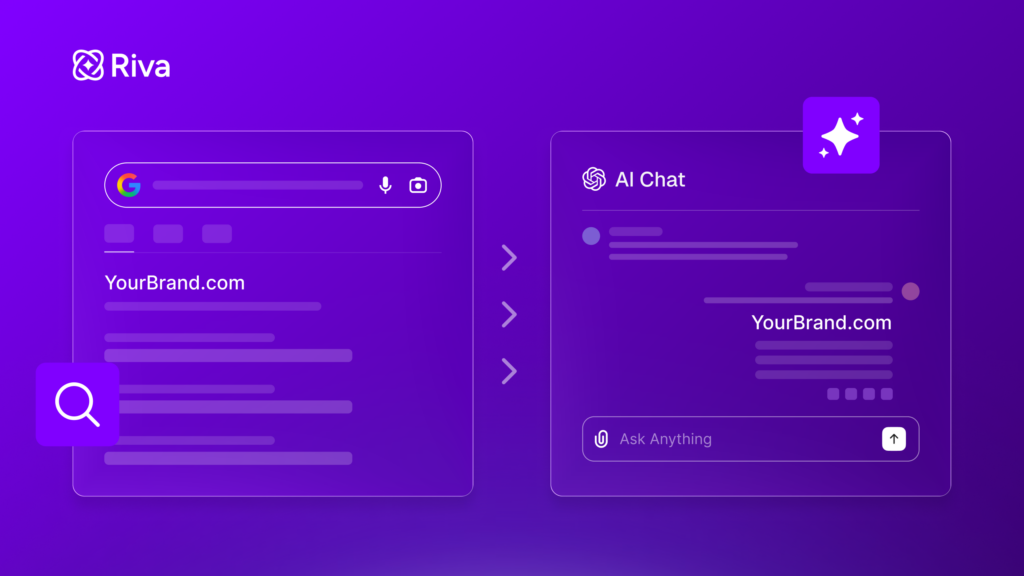

AI visibility is whether AI tools such as ChatGPT, Gemini, and Perplexity can access a business’s website, correctly understand what it offers, and recommend it accurately when someone asks a relevant question, distinct from where that business ranks in traditional search results.
For twenty years, SEO has operated on a consistent assumption: the buyer journey begins with a search results page. Optimize for the click, and everything downstream, conversion rate, retention, lifetime value, is the website’s problem to solve.
That assumption is breaking. Not because rankings stopped mattering, but because a growing share of research now happens before a results page ever loads.
The buyer journey no longer starts on a results page
When a prospective buyer asks ChatGPT, Gemini, or Perplexity to recommend a vendor, compare two products, or explain what a company does, the AI tool answers directly. No click occurs. No session gets logged in Search Console. The business is either represented accurately in that answer, represented poorly, or absent entirely, and the buyer has usually formed a mental shortlist before analytics know anything happened.
What rank tracking doesn’t tell you
This should concern anyone running technical SEO: a page ranking on position one can be simultaneously invisible, misclassified, or replaced by a competitor inside an AI-generated answer.
Rank tracking measures where a URL sits in a results list. It says nothing about whether a large language model has correctly parsed what a business sells, who it serves, or why it differs from the competitors it might mention instead.
Riva, the AI visibility platform formerly built as XOVI AI and now available as its own standalone product, exists to close that specific measurement gap. It’s worth being precise about what it actually checks, because the value isn’t in the concept of “AI visibility,” it’s in making that concept auditable.
The four layers Riva measures
Riva evaluates visibility across four connected layers, each building on the one before it:
Riva evaluates visibility across four connected layers, each building on the one before it. In short: access, then understanding, then visibility.
Can AI tools reach the site at all (technical accessibility), do they understand what the business actually offers (business-level and product-level completeness), and does the offering show up when it matters (visibility against named competitors). Each layer only matters if the one before it passes:
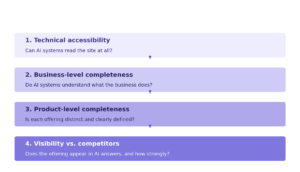
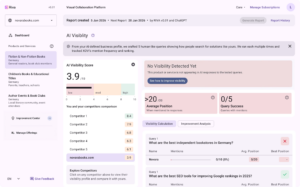
The fourth layer is the one most teams care about most: which named competitors are showing up in AI answers instead of you, and how consistently. That gets benchmarked into an AI Visibility Score, average position, and query success rate, tracked against those same competitors over time.
Why this runs alongside SEO, not instead of it
None of this replaces SEO. It can’t and treating it as a substitute misreads the shift underway. Search engines and AI systems are not converging into one discipline; they’re diverging into two, with different accessibility requirements, different signals of relevance, and different failure modes.
A technical SEO issue can hurt rankings without affecting how an AI tool describes a business. A vague product description can tank AI visibility without touching organic traffic. Auditing one and not the other leaves half the buyer journey unmeasured, at exactly the point where the buyer is forming their shortlist.
Technical accessibility audits, keyword and rank tracking, and AI visibility monitoring are answering three different questions that all matter to the same prospective client: can they find you, can they reach you, and does the system doing the recommending actually understand what you sell.
Standalone changes the calculus
Riva no longer requires an existing XOVI subscription to run. That makes it a defensible line item in an agency retainer independent of whatever SEO stack a client already has in place. Concretely: agencies can package it as a recurring AI visibility service, sold and re-sold across the client roster, backed by monitoring that reruns on a fixed two-week cycle rather than a one-time snapshot that’s stale by the next model update.
The question clients are about to start asking
Rankings tell you where a business stands in search. Riva tells you whether the systems increasingly standing between a buyer and their decision understand that business correctly. Increasingly, that second question is the one clients are going to start asking first.
Frequently Asked Questions
What is AI visibility?
AI visibility is whether AI tools like ChatGPT, Gemini, and Perplexity can access, understand, and accurately recommend a business, separate from how that business ranks in search engines.
How is AI visibility different from SEO?
SEO measures and improves how a site ranks in search engine results. AI visibility measures whether AI tools correctly understand and represent a business when answering a question directly, without a results page involved. They rely on different signals and can move independently of each other.
If a business already ranks well in Google, does AI visibility still matter?
Yes. Strong rankings don’t guarantee strong AI visibility. A page on position one can still be misclassified, incompletely described, or replaced by a competitor inside an AI-generated answer.
What does an AI visibility audit actually check?
A thorough audit covers four layers: technical accessibility (can AI systems read the site), business-level completeness (do they understand what the business does), product-level completeness (is each offering distinct and clearly defined), and visibility versus named competitors.
Can AI visibility be monitored the same way as search rankings?
Not with the same tools. Rank trackers query search engines. AI visibility monitoring requires querying AI tools directly with realistic prompts and evaluating how the business appears in the response, then repeating that on a fixed schedule, since AI-generated answers shift as models update.
Does adopting an AI visibility tool replace the need for SEO?
No. SEO and AI visibility address different discovery systems with different failure modes. A technical SEO issue can hurt rankings without affecting AI visibility, and a vague product description can hurt AI visibility without affecting organic traffic. Most teams need both running in parallel, not one replacing the other.